Showing posts with label PGV. Show all posts

Saturday, November 10, 2012

Hawaii County Approves Nighttime Drilling Ban

by Peter Sur (Tribune-Herald)

Puna Geothermal Venture must stop nighttime geothermal drilling, the County Council said, sending a bill to Mayor Billy Kenoi’s desk.
The vote was 5-2, with councilmen Fred Blas and Donald Ikeda excused. Council members Brenda Ford, Pete Hoffmann, Angel Pilago, Brittany Smart and Chairman Dominic Yagong all voted in favor of it, with council members Dennis Onishi and J Yoshimoto opposed.
But the final test will be approval of the mayor, because supporters of Yagong’s bill did not have the six votes needed to overcome a potential veto.
The vote came around 6:25 p.m., when lawmakers were so weary that at one point the chairman addressed Ikeda as “Mr. Amendment.”
Yagong was referring to an amendment that Ikeda had introduced that would have exempted geothermal drilling operations from additional regulations prior to the expiration of PGV’s current permit. That amendment was defeated by a vote of 5-3, with Ikeda joining Onishi and Yoshimoto in support.
With a few notable exceptions, most of the public testimony was in favor of the measure that prohibits exploratory and production geothermal drilling from 7 p.m. to 7 a.m. when it’s done within a mile of a residence.
The bill is targeted at the only geothermal production well in Hawaii, Puna Geothermal Venture. People living nearby have complained about the constant noise emanating from the plant.
“The noise impact is real. It affects people here,” said Tom Travis.
PGV plant manager Michael L. Kaleikini submitted testimony against the bill. He cited several concerns, chief among them that “stopping drilling at night will not eliminate the sound produced from mandatory equipment that must run for the entirety of drilling,” Kaleikini said in written testimony. “Quite simply, the bill will not accomplish its purpose.”
“Passing Bill 292 is not consistent with safe drilling practices, will not serve to substantially reduce noise, and will greatly increase costs to ratepayers,” Kaleikini wrote. “Geothermal power has the potential to provide the most inexpensive renewable energy on the Big Island. Bill 292 would severely compromise this potential.”
Since the plant began, PGV has drilled no less than 10 wells without being forced to curtail evening drilling, Kaleikini said. Since receiving its most recent development permit, PGV has drilled seven wells.
The last drilling of a well ended in July and took 120 days; prior to that a well that was drilled in early 2010 took 90 days, Kaleikini said.

Thursday, October 18, 2012

Council to Hold Hearing for Nighttime Geothermal Drilling Ban

By TOM CALLIS
Stephens Media
tcallis@hawaiitribune-herald.com

A proposal to prohibit geothermal drilling at night ran into a snag Wednesday when the Hawaii County Council opted to hold a public hearing on the issue rather than take a final vote.

Hilo Councilman Donald Ikeda proposed the hearing, approved in a 5-3 vote, citing confusion over whether the nighttime ban would apply to Puna Geothermal Venture. Council members Fred Blas, Brenda Ford and Pete Hoffmann voted no.

The hearing, to be held in Puna on a yet-to-be-determined date, would follow two bill readings by the council and a positive recommendation from the council’s Agriculture, Water and Energy Sustainability Committee. Public testimony was taken at the three previous meetings, sometimes at length, from supporters of the ban as well as PGV representatives.

Ikeda said the hearing would allow PGV to better explain what it does to limit noise during drilling, as well as its “vested rights.” He also mentioned what he saw as a disconnect between some of the testifiers and how PGV runs its 38-megawatt plant, the only geothermal facility in the state.

“I don’t like to be the only dissenting vote, look like I don’t support the people,” Ikeda said before proposing the hearing. “I do, but I also believe Puna Geothermal has rights, too.”

A few council members said they believe the county’s legal staff determined that the bill couldn’t affect drilling at PGV since it already has a permit from the Windward Planning Commission for future drilling, and questioned the need for a hearing.

“I think I heard the Corporation Counsel clearly indicate it can’t be retroactive,” Hoffmann said.

“Therefore, I don’t see PGV related to this issue at all.”

Hilo Councilman Dennis Onishi said he had the same interpretation.

“I think people could misinterpret what could happen,” he said.

Hilo Councilman J Yoshimoto suggested the council adopt an amendment stating the bill doesn’t apply to PGV.

Council Chairman Dominic Yagong, who introduced the bill, said an amendment is not necessary, leading to it being dropped during discussion.

“I think the (executive) session we went through was quite clear,” he said. “I don’t think there is any confusion there.”

Deputy Corporation Counsel William Brilhante said he couldn’t comment on whether the bill would apply to PGV, citing potential liability.

Either way, the bill would still apply to new geothermal operations.

Brilhante said enforcement would be up to the county Planning Department.

Planning Director Bobby Jean Leithead Todd couldn’t be immediately reached for comment.

The bill was prompted by drilling at PGV earlier this year that some nearby residents said was too disruptive and caused them to lose sleep.

PGV Plant Manager Mike Kaleikini told the council he received about 45 complaints during drilling, lasting from March 1 to July 7.

That’s up from the four complaints during drilling in 2010, which he said was a few decibels louder.

Kaleikini said the plant uses insulation and a barrier wall to reduce noise.

It’s also considering adding another wall, he said.

Friday, October 5, 2012

Hawaiian Volcanos Observatory Scientists Say Geothermal Drilling Won't Cause Sinking

Kilauea Volcanic Rift Zones subside whether or not they host geothermal developments

Recently, Hawaiian Volcano Observatory scientist’s have been asked if Hawaii Island’s geothermal development causes subsidence of the ground surface, as has been observed at U.S. mainland geothermal areas, such as those in California– Coso, Geysers, the Imperial Valley, and Casa Diablo in the Mammoth Lakes area.

The largest of these mainland developments is heated by magma reservoirs that supplied eruptions through non-volcanic rock layers. The magma, thousands of years old, still heats groundwater within California’s sedimentary basins, where, fluid withdrawal during geothermal energy production can reduce pressure within the subsurface rock formations. When this happens, the ground surface subsides.

The highest subsidence rates are measured at the Geysers Geothermal Field within the Clear Lake Volcanic Field in northern California. The 78 square kilometer (30 sq mi) developed area produces 1,500 megawatts (MW) of electricity from a vapor-dominated reservoir within fractured sandstone that is capped by a zone of rock filled with geothermal minerals at the top and heated by magma below.

The Clear Lake volcanic field is one of several in California and Nevada that are monitored by HVO’s sister California Volcano Observatory (CalVO; http://volcanoes.usgs.gov/observatories/calvo/). CalVO also monitors the Long Valley caldera, in which the Casa Diablo geothermal development (40 MW) is located; the Salton Buttes volcano, which includes the Imperial Valley geothermal field (>300 MW); and the Coso Volcanic Field, where a 270 MW geothermal development is located.

As volcanic activity waxes and wanes, each of these areas exhibits its own deformation and seismicity. For example, the Long Valley caldera has experienced several episodes of heightened unrest, including earthquake swarms, ground uplift, and volcanic gas emissions during the past several decades. Thus, CalVO watches this area closely. The subsidence related to geothermal development must be documented carefully to separate the effects of volcanic activity from those due to drilling and energy production.

Monday, September 24, 2012

Lowering the Balance of Power? HELCO Wants to Renegotiate its Power Purchase Agreements with Renewable Energy Providers

HILO — Hawaii Electric Light Co. wants to renegotiate its power purchase agreements with renewable energy providers.

Earlier this week, the County Council approved by a 9-0 vote a resolution urging HELCO to renegotiate its contracts based on the price of energy production rather than “avoided cost,” which ties the cost of producing renewable energy to the price of oil on the market.

“We are in agreement with the resolution,” said HELCO President Jay Ignacio on Friday. He testified in favor of the renegotiated contracts when the resolution came before a County Council committee.

Councilman J Yoshimoto said the idea for the resolution came out of a discussion about general energy issues with HELCO officials earlier in the year.

Last December, the Public Utilities Commission approved an amended purchase power agreement between HELCO and PGV to purchase an additional 8 megawatts of power that would expand production to 38 megawatts and provide monthly savings of between $1.60 and $1.90 per customer through 2025.

Those savings struck a lot of people as not enough, given Hawaii Island’s reliance on imported fuel for energy.

“The savings that resulted out of the recent negotiations that HELCO had with PGV were minimal,” Yoshimoto said. That’s why he wrote the resolution to “ask both parties to go back to the negotiating table. That’s the bottom line.”

Ignacio was hopeful PGV was looking to renegotiate at least one of its contracts.

“They (PGV) have approached us and asked to renegotiate the part of the contract governing the first 25 megawatts, and they recognize the problem,” Ignacio said. “We have sent invitations to all the other power producers inviting them to come back and negotiate the energy contracts.”

As stated in the resolution, HELCO will provide the County Council an update on the status of its efforts at its meeting Oct. 17 at the West Hawaii Civic Center. This update will include whether PGV “was amenable to lowering the price rates for payers and the amount of the new negotiated price, if one has been agreed upon.”

Yoshimoto said he was hopeful the negotiations result in savings.

Ignacio, interviewed separately, agreed.

“I do hope so,” the HELCO president said. “From the electric utility’s perspective, we want to get lower cost contracts so we can pass the savings on to consumers.”

“The only assurance that we have is that they negotiate in good faith,” Yoshimoto said.

Hawaii County residents pay some of the highest costs per kilowatt in the nation.

While the Legislature has passed a law mandating that future energy contracts be decoupled from the price of oil, that doesn’t help the existing long-term contracts, some of which are for 20 or 30 years, that rely on the avoided-cost model.

HELCO also has purchase power agreements with two wind farm firms, Apollo Energy Corp./Tawhiri Power LLC and enXco/Hawi Renewable Development; and hydroelectric plant Wailuku Holding Co.

Source - Hawaii Tribune Herald

Saturday, July 14, 2012

Mayor Vetoes Geothermal Bills

Hawaii County Mayor Billy Kenoi
By PETER SUR
Tribune-Herald staff writer

A pair of bills relating to geothermal energy have died on Mayor Billy Kenoi’s desk, unless the County Council can engineer an override of the veto. Both bills generated tremendous public testimony prior to their passage by the County Council last month. Kenoi’s veto messages described both as unnecessary legislation.

One bill would have required the county Civil Defense Agency to prepare an emergency response and evacuation plan for geothermal facilities and to submit it to the County Council for approval by Aug. 1. The bill is aimed at people living near Puna Geothermal Venture. The bill would have allowed the administration to ask for a 90-day extension to write the plan.

Kenoi’s veto message for the Civil Defense bill states that first responders already have a plan for all emergency situations, including geothermal, based on the Federal Emergency Management Agency-developed incident command system.

“Since effective plans are already in place, there is no need for a new plan,” Kenoi wrote.
Council Chairman Dominic Yagong, who introduced both bills, said he was disappointed with the mayor’s action.

“In my estimation, that’s playing politics with people’s lives,” he said.

Councilwoman Brenda Ford said residents of lower Puna should have an idea of what to do in the event of a geothermal mishap.

“The community needs a plan on what to do, and they need guidance from the county on how to respond to a disaster,” he said. “You know, Plan A, Plan B, Plan C. That has not occurred, and I am supportive of that type of community evacuation plan being designed by the county and delivered to all the residents so that they know what to do.”

Ford said the county uses its incident command system “beautifully,” but “the average citizen hasn’t a clue what to do.”

A community evacuation plan would help in that situation, she said.

The other vetoed bill, which would affect people in lower Puna, would have renamed the Geothermal Relocation and Community Benefits Program to the Geothermal Relocation and Public Safety Program, although it’s popularly known as the “geothermal royalties” fund.

This bill would have redirected money from the community benefits program into uses that relate to public health and safety, including air quality monitoring and a public notification system. It would also have made eligible for relocation all homes within a mile of Puna Geothermal Venture.

“The thought that the county would not let us use money to determine what is making these people ill is the most egregious, lack of concern and compassion I have ever heard of,” Ford said. “These people are not making up these illnesses.

“Now, I do not know what is causing it,” Ford said. “They’ve got problems and nobody’s looking at it. … They’ve got very unusual illnesses.

Kenoi’s message to the council says the bill duplicates the purpose of the $2.1 million Geothermal Asset Fund, which is dedicated to funding public health and safety mitigation measures.

Kenoi also wrote that a “significant number” of people who have seen community benefits from PGV would like to see those benefits continue. But Ford said there were “far more people” who supported the bill than opposed it. She pegged the number of supporters at 60 to 70 percent of those who testified.

Kenoi wrote that the bill would result in lower tax revenues for Hawaii County by acquiring and holding homes from people who wish to be relocated, and liability issues that would arise from those vacant homes.

“It would be irresponsible for me to sign (the bill) into law due to its legal and technical flaws and because it is unnecessary,” Kenoi wrote.
But his critics think otherwise.

“Is he saying that health studies are inappropriate? Is he saying that the people of Puna are making these stories up?” Yagong asked.

Kenoi said that’s not the issue.

“The goals of protecting public health, safety and doing a thorough, comprehensive health study, we can already achieve through existing legislation and authority,” he said, and said the county was going to conduct a “thorough, open, transparent and community-involved study with health care professionals, independent researchers who have already inquired. … We’ll go to the community to address those goals.”

“We don’t believe this legislation is based on good science, good authority,” Kenoi wrote. “There’s too much ambiguity, and the first hurdle in signing any piece of legislation is a good law. And unfortunately this legislation has too many flaws.”

The County Council approved the evacuation plan bill by a 7-2 vote and the relocation and public safety bill by a 6-3 vote. Yagong has not indicated whether he would call for a veto override.

Email Peter Sur at psur@hawaiitribune-herald.com.

Source: Hawaii Tribune Hearld

Wednesday, July 4, 2012

Early Industry Practices Brought to Light at Recent Hawaii County Council Hearing

Mililani Trask Brings Light to Early Hawaii Utilities Industry
Monday, July 2, 2012 - Hilo, Hawaii

Mililani Trask addresses the Hawaii County Committee on Agriculture, Water, and Energy Sustainability. Near the end of her presentation, she has brought to the Council Member's attention a few archived documents of early Industry between the utility companies here in Hawaii.


Hawaiian Electric Industries Inc. (HEI) of Honolulu, and Ormat Energy Systems Inc. of Sparks, Nev., Monday announced the execution of a Memorandum of Understanding to jointly develop geothermal power plants on the island of Hawaii. The parties said they hope to enter into a final partnership agreement by the end of October. Under the terms of the Memorandum of Understanding, Ormat will sell 50 percent of its subsidiary Puna Geothermal Ventures (PGV) to HEI subsidiary Hawaiian Electric Renewable Systems (HERS). Ormat will continue to be the managing partner for geothermal projects to be developed by the partnership.
 
PGV is the first company to receive necessary government approvals to develop a commercial geothermal energy plant in Hawaii. A 25 megawatt plant is expected to be operational by the end of 1990. PGV has a contract to sell electricity produced by the plant to Hawaii Electric Light Co., which serves the island of Hawaii. In addition to PGV's 500 acre power plant site, PGV has surface rights on another 10,000 acres in the Puna district of the island, with mineral lease rights on 4,500 of those acres. A small experimental geothermal power plant owned by the State of Hawaii has been generated in this area since 1982.
 
Hezy Ram, president of Ormat Energy Systems said: "We see a great deal of synergy in joining forces with HEI. Ormat brings 25 years of worldwide leadership in developing pollution-free power plants utilizing locally available heat sources, as well as the track record of developing and operating nine geothermal power plants, with two more under construction. "HERS, on the other hand, is uniquely positioned to assist the partnership in all matters pertaining to doing business in Hawaii."
 
HEI President C. Dudley Pratt, Jr. said HEI "is pleased to be an active participant in the development of geothermal energy in Hawaii. Ormat has an excellent record of environmental protection wherever it has built geothermal energy plants. HEI is committed to being a leader in renewable energy development in the state, and our agreement with Ormat supports this goal."
 
HEI's other renewable energy projects in Hawaii are windfarms on the island of Hawaii and Oahu. The Oahu facility includes the world's largest horizontal axis wind turbine now in operation, the Boeing MOD-5B.

Download Document: HERE

Sunday, June 17, 2012

Two Geothermal Bills Move Forward on Big Island


By Leslie Blodgett, GEA
June 13, 2012

Monday, June 11, 2012

Relocation Requests Rise

Tribune-Herald staff writer
Hawaii County has spent $646,407 purchasing homes near Puna’s geothermal power plant, but that number could soon be about to rise.
Joaquin Gamiao, planning administrative officer, said the department is processing seven relocation requests that could end up increasing that amount by about 55 percent.
“We’re out about $1 million,” he said, if all are approved.
The requests have all been submitted in the past month, Gamiao said, after the geothermal issue once again took center stage with the County Council.
The money comes from the county’s geothermal royalty fund, which now has about $3.3 million, according to the Finance Department.
It is funded with the county’s share of royalties from Puna Geothermal Venture. The amount the county receives varies based on production levels, but has hovered recently around $500,000 a year, Gamiao said.
To date, the county has approved five relocations with the latest acquired April 5, according to records provided by the Planning Department.
County staff previously said eight homes were acquired, but some of those were duplicates or had their applications withdrawn.
The homes cost between $60,770 and $237,380 to acquire.
The average property has cost the county $129,281 to purchase.
All were purchased at 130 percent of their value, Gamiao said, as allowed by county policy. They were also located within a mile from the plant, Gamiao said.
The county has auctioned four of those properties to date, for a total amount of $216,100.
The county would be prohibited from auctioning properties acquired through the relocation program under a bill being considered by the County Council.
Gamiao said that would not impact the purchase of the seven properties under consideration. The Planning Department is not delaying processing the requests until the bill has its final vote, likely June 19.
“We’re doing what we need to do know,” he said.
County Council Chairman Dominic Yagong introduced the bill with the intent of creating a one-mile buffer zone.
The fund was established in 1998. Previously, the county’s royalty funds were accruing interest but not being used, Gamiao said.
In 2008, the County Council amended the policy to allow the funds to be used on capital projects and other services for Lower Puna.
Yagong’s bill would also amend the fund to only allow the monies to be spent on relocations as well as air quality and health studies near the plant and provide other means for ensuring safety, such as air monitors for residents.
Yagong said he thinks the fund is receiving enough revenue to cover at least some of those items if relocation requests continue.
“The fact of the matter is we have money that is available and of course we should use the money to do what we can to help the people there,” he said. “That fund will continue to grow.”
Some Puna residents have voiced concern over ending funding for services for the district.
The royalty fund currently covers the Pahoa council office as well as security for at Isaac Hale Beach Park and Pahoa Community Center.
Yagong said he is working on a third geothermal bill that would allow another geothermal fund to cover such expenses.
The second fund, known as the geothermal asset fund, was established in 1989 to reimburse nearby residents adversely affected by the plant.
It has $2.1 million, according to the Finance Department.
Gamioa said it is funded with a $50,000 annual contribution from PGV. There’s no record of it ever being used, he said.
Yagong said the bill, which will likely be introduced July 2, would also create a commission to recommend what projects should be funded.
The commission would consist of five Puna residents appointed by the mayor and County Council.
“We’re putting the asset fund into the hands of the community,” he said.
Yagong said the bill would limit expenditures from the fund to $350,000 a year.
Email Tom Callis at tcallis@hawaiitribune-herald.com.

Wednesday, June 6, 2012

Council to Mull Geothermal Buffer Zone

The full impact of a bill to create a buffer zone around Puna Geothermal Venture’s plant remains to be seen, county officials said Monday.
Bill 256, proposed by Council Chairman Dominic Yagong, goes before the full council Wednesday in Hilo for first reading. Yagong said the bill is the first step in dealing with the potential health ramifications of living so close to the geothermal energy production plant, although it could also have impacts, in the future, on people living in other parts of the East Rift Zone.
“The real key is, we need to take care of the people around the plant first,” Yagong said, adding that whether the buffer zone should extend farther into the rift zone is a good question. “We can go and expand it even farther from there (the proposed one-mile buffer).”
One thing the county cannot do, he added, is force people to leave their homes, even in a buffer zone.
Yagong’s proposal would move responsibility for the geothermal royalty funded Geothermal Relocation and Community Benefits program, which would be renamed the Geothermal Relocation and Public Safety Program, from the Planning Department to Civil Defense. Bill 256 would also allow spending relocation money for health studies, Yagong said.
Yagong said it would be up to Civil Defense to decide whether to conduct health impact studies before relocating residents. Civil Defense Director Ben Fuata was out of the office Monday. Mayor Billy Kenoi did not immediately respond to a message left Monday afternoon.
Planning Director Bobby Jean Leithead Todd said Yagong’s bill is “superfluous,” because the county already has the authority to spend the royalty money to relocate residents.
Homeowner relocation requests have increased significantly — from two between 2005 and 2011, to seven in the last few months — after the County Council began debating the bill, she added.
The existing program does give priority to people who have owned the house since before 1991, she said, but anyone living within that radius may apply for the program.
The department continues to issue permits, she said, because not doing so might be construed as the county taking an owner’s property.
Leithead Todd said one change to the existing relocation program she’d like to see in place is the ability for the county to purchase vacant land adjacent to the plant. Doing so would create a better buffer and would be cheaper than just buying homes.
“If I’ve got to buy the house at 130 percent of real property appraisal, that’s a lot more money,” Leithead Todd said.
Officials with Puna Geothermal Ventures’ owner, Ormat Technologies, expressed concerns about the bill Monday, through Policy and Business Development Director Paul Thomsen. Thomsen provided West Hawaii Today with a letter, being provided to community members, explaining the technology used within the plant, including the reinjection of the brine heated to create the steam that powers the turbines.
“PGV must operate under stringent air emission, water quality and noise standards set forth by the Hawaii Department of Health and Environmental Protection Agency,” Thomsen wrote. “In doing so, PGV continually monitors (hydrogen sulfide) through 35 point-source detectors placed throughout the power plant. PGV also maintains three monitoring stations that are located on the perimeter of the facility. These stations monitor meteorological and noise data, which can be viewed on the company website and is provided in a formal report given to the (Health Department) on a monthly basis, or as requested. For over 20 years, PGV has complied with state-mandated emissions standards.”
PGV also submitted a letter to Agriculture, Water and Sustainability Committee Chairman J Yoshimoto, requesting time to discuss the plant’s safety protocols and respond to the community’s concerns.
Thomsen said he sees bigger issues facing Puna residents than PGV, particularly naturally occurring pollution of water as it flows from Mauna Loa through the East Rift Zone, picking up chemicals from magma along the way.
“So the fresh water aquifer between the East Rift Zone and the ocean, from Volcano to Kapoho does not meet EPA drinking water standards,” Thomsen said. “This is a natural process that has been going on for millennia and is the source of the warm ponds along the coast from Kapoho to Kalapana. … Natural emissions from the rift in the Puna District are much greater than any potential emissions from PGV.”
He noted a 1998 Department of Health study that found no adverse health impacts from living near the plant.
The council on Wednesday also takes on the first reading of another Yagong measure, this one to ban aerial game hunts in Hawaii County. Bill 261 “declares that the acts of eradication by aerial shooting on this island shall no longer be practiced, and ensures that other methods of animal population control are utilized.”
Mainland magazine Outdoor Life ran an article online last week urging hunters to contact Yagong and tell him they opposed aerial hunting.

Tuesday, June 5, 2012

Harry Kim to File for Mayor

By Dave Smith - June 4, 2012
Source: Big Island Now
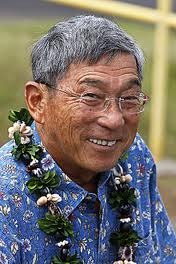
Harry Kim, above, has decided to run again for Hawaii County mayor. Wikipedia photo.
Former two-term mayor Harry Kim today took out nomination papers to run for the chief executive position on the Big Island.

Kim told Big Island Now this afternoon that he will definitely file to run for mayor tomorrow, which is the election deadline for the Aug. 11 primary election.

Kim’s candidacy adds a significant twist to the mayor’s race where he will become the 10th candidate, according to Friday’s report from the state elections office.

Those with the highest profiles, incumbent Mayor Billy Kenoi and County Council Chairman Dominic Yagong, could not be immediately reached for comment.

Kim, 72, served as mayor from 2000-2008 after a 24-year stint as director of the county’s Civil Defense Agency. He was prevented by term limits from running for re-election immediately after that.

Kim knows his chief opponents well.

Yagong ran against him for mayor in the 2004 nonpartisan primary where he received 26% of the vote to Kim’s 62%. Kim has known Kenoi for many years and coached him as a player on the Waiakea High School football team. Kenoi also served as an executive assistant in the last six years of Kim’s administration.

Kim said he didn’t have qualms with either candidate who he said have a “different style of management” from him. Kim had endorsed Kenoi’s bid for mayor in 2008.

Kim said today that his return to politics was largely driven by actions that occurred during the past session at the state Legislature dealing with geothermal development.

He said he was disheartened by the easing of restrictions for those activities including the removal of the requirement for subzones for geothermal development.

But what prompted him into direct action, Kim said, was a request from DLNR Director William Aila Jr. to the state Environmental Council. Aila had asked the panel to exempt exploratory geothermal drilling from the state law that mandates the preparation of an environmental assessment or the more rigorous environmental impact statement.

Kim said he was dumbfounded when a committee of the council voted almost unanimously to recommend approval of Aila’s request.

“I couldn’t believe (the committee) did this,” Kim said. “I said, nah, they wouldn’t do that.”

After being urged to intervene by Gary Hooser, head of the state Office of Environmental Qualify Control, Kim spent four days researching the matter and preparing testimony.

After Kim appeared in person before the full Environmental Council in Honolulu, its members reversed the committee’s recommendation and voted to deny the change Aila had requested.

After that, “I really started thinking about geothermal, safety and health in government,” he said. “How could they do this?”

Kim said he also wondered how, if the exemption stood, government could justify requiring environmental studies for other types of projects.

Kim said his jaw dropped when he heard Aila say drilling for geothermal is comparable to drilling for water.

“I realize that some people truly think that geothermal is harmless,” he said. “I would think people in authority should do some research.”

Kim said he decided to re-enter politics to make sure geothermal and other development “is done right.”

“I realized that it’s not just about geothermal, it’s about faith in government,” he said.

Kim said another subject he is concerned about is solid waste. He said he has never been a proponent of landfills anywhere in Hawaii, and believes the solution is a plant like Oahu’s H-Power where garbage is burned to generate electricity.

He acknowledged that the waste-to-energy facility considered during his second term carried a steep price tag of $125 million, but feels that it’s the government’s duty to find a way to do it affordably.

He said he was also opposed to the County Charter amendment that set aside 2% of county revenues to purchase land to be preserved as open space, partly because it didn’t include funding for maintenance of those lands.

“That’s not a good way to spend public money,” he said, adding that such funding should be found elsewhere.

In the area of public funding, Kim will likely be subjected to questions about his administration’s practice of increasing the size of government during flush times, when soaring property values inflated county coffers.

During Kim’s eight years in office, the county’s operating budget more than doubled to more than $400 million. That included a tax increase of nearly 25% for homeowners sought by Kim and approved by the council for the 2002-03 fiscal year.

Kim said today he will run a campaign similar to his other two, in which he describes himself as an “applicant” for the mayor’s job.

While he has relatively little time for fundraising, that also includes continuing his policy of not taking any campaign donations greater than $10. Kim said no amount of advertising he could purchase would overshadow public perception of his years of public service.

“I worked for the people here for more than 40 years, and by now they should know me and my methods,” he said.

Kim acknowledged that his health could be an issue in the campaign, as he suffered two heart attacks in his final year in office.

“My health at this point is good,” he said, while acknowledging that he is currently undergoing additional cardiac testing.

He also admitted that because of the health issues his family did not want him to run, but supports his decision to do so.

County Council Must Address Community Impact from Geothermal


James Weatherford
The Hawaiʻi County Council is considering legislation to redirect the county's share of geothermal royalty funds back to their original purpose - addressing community impacts from geothermal development.
James Weatherford, candidate for Hawaiʻi County Council District 4, fully supports this initiative and says Bill 256-12 must be passed.
“This is not about being 'pro' or 'anti' geothermal. This is about responsible government being responsive to community concerns," Weatherford said in a statement released by his campaign today.
"The incumbent from Puna has had a year-and-a-half to address the concerns of the community in the vicinity of the geothermal plant," Weatherford added. "Instead of responding to and addressing his constituents' concerns regarding impacts of geothermal in the community, he has been spending geothermal funds for other purposes. Instead of draining the geothermal royalty fund, I will bring Puna taxpayers’ money back to Puna by doing the work required through the budget process to get capital improvement projects for the district.”
Bill 256-12, introduced by Council Chair and Mayoral Candidate Dominic Yagong, will provide an opportunity for residents now living within one mile of the Puna Geothermal Venture facility to be relocated, and would prevent those properties from being reinhabited via resale or rental. This will start to create a buffer around PGV, where as now, some residents live right next to the geothermal power plant.
In addition to relocation, Bill 256-12 also promotes public health and safety by providing expenditures on health studies, air quality monitoring and real-time public notification of emissions.
Mandated emergency evacuation preparedness is also being considered by the council in a separate measure.
On May 16th, the legislation received a favorable recommendation from the Council’s Agriculture, Water, and Energy Sustainability Committee. Scheduled for June 6th is the first of two more votes needed before being sent to the Mayor for signing into law or veto.
Submitted by the campaign of James Weatherford for Puna Council District #4
More on the web: www.jamesweatherford.com

Source: Hawaii Reporter

Thursday, May 17, 2012

Environmental Exemptions for Geothermal Energy near final Approval


Unlike wind or solar, geothermal energy located deep below the earth's surface is always on.
But companies will often shy away from exploring new geothermal sites in Hawaii because of the state's strict environmental regulations, which cost both time and money.
On Thursday, a subcommittee of the state Environmental Council heard from potential geothermal developers about why the State Land Department should be allowed to waive certain environmental regulations.

"The cost and timelines of the current rules make it restrictive to explore in this state," said Bill Sherman, land manager for Ormat Technolgies, a Nevada based company that owns the 30 megawatt geothermal plant in Puna on the Big Island.
After hearing testimony, the seven member subcommittee approved three environmental exemptions for geothermal exploration. They include non-invasive testing and analysis, the issuance of leases on state or reserved lands, and the drilling of exploration wells.
If approved by the full 15-member Environmental Council May 17, the exemptions would allow the State Land Department to drop costly environmental assessments from geothermal exploration projects.

"This simply gives us the opportunity to point out an exemption for the environmental processes," said State Land Director William Aila. "There's still all of the other state, federal and county processes that have to be complied with."

The 30-megawattt Puna Geothermal Venture plant already produces 20 percent of the Big Island's energy needs. Allowing exploration wells to be dug more quickly and cheaply could lead to the construction of more plants.

Ormat is exploring the construction of a 50-megawatt geothermal plant on Ulupalakua Ranch in southern Maui. Meanwhile, Hawaii Electric Light Company opened a docket with the Public Utilities Commission May 1, asking for proposals to build a new 50-megawatt geothermal plant on the Big Island.

In his State of the State speech in January, Gov. Neil Abercrombie lobbied for more renewable energy output and mentioned the Big Island by name.

"That's really in response to the demand that's coming from the community on Hawaii Island," said Aila. "They're paying some of the highest prices for electricity in the state."

However, opposition to the geothermal industry on the Big Island continues to grow louder, where critics blame a variety of health problems on the Ormat plant in Puna.
Gary Hooser, an ex-officio member of the Environmental Council and director of the Office of Environmental Quality Control, believes geothermal technology doesn't harm human health, even though he voted against the exemption for exploratory wells.

"I think if done properly, like most things, geothermal can be perfectly safe," said Hooser. "We need to explore all these alternatives to renewable energy."

Longtime native Hawaiian activist Mililani Trask is currently representing Innovations Development Group, Inc., a company which hopes to dig geothermal exploration wells on the Big Island.

Although members of The Pele Defense Fund have begun speaking out against the interference geothermal plants could pose to native Hawaiian Pele practitioners, Trask says those concerns are overblown. She points to a 1995 decision by the Hawaii Supreme Court that affirmed access rights of native Hawaiians.

"Since that time and until the very present moment, there hasn't been a single case of a single Hawaiian prevented from worshiping tutu Pele because of a geothermal plant in Puna," said Trask. "It just hasn't happened. It's a non-issue."