Showing posts with label Hawaii County Council. Show all posts

Saturday, October 20, 2012

Public Protest Too Much For PLDC?

By Dave Smith
public-land-development-corporation-protest
A protest over the Public Land Development Corporation. Photo courtesy Hawaii News Now.
It looks like it will be try, … again for the Public Land Development Corporation.
The controversial new state agency designed to increase revenues from state lands using public-private partnerships is continuing its efforts to establish its administrative rules.
Following statewide hearings in August, the agency revised the guidelines and added a strategic plan.
The PLDC’s five-member board met on Thursday and voted to take the amended rules to public hearing.
However, only one of those is planned, on Nov. 13, and that will be on Oahu.
Lloyd Haraguchi, the PLDC’s executive director, was not available for comment on why other islands were not included in the schedule.
According to a statement from the PLDC, even though state law required only one hearing be held, the agency’s board of directors in August took the “extra step” of holding hearings statewide. The reason, it said, was to familiarize the public with the new state entity.
Now the PLDC says it will hold an additional public hearing on the amended rules, as required by law.
The rules can be viewed at hawaii.gov/dlnr/pldc, and “any member of the public may submit advance testimony via email or USPS mail by Tuesday, November 13,” the agency said.
“The PLDC remains committed to transparency, and its newly adopted strategic plan, project flowchart and rule amendments show that opportunities for public comment actually expand under the PLDC for potential projects,” the statement said.
But one can’t help but wonder if the primary reason for not taking the revised rules on the road is that the PLDC – and its director – have had their fill of the rough reception they received across the state.
The first time the agency took the draft rules out for public hearings, it encountered large and hostile crowds.
And recent public protests across the state drew hundreds of participants.
Sierra Club Chapter Director Robert Harris described the PLDC’s decision to hold only one public hearing a “new low” for the agency. He went on to say that Haraguchi was “insulting thousands of neighbor island residents by excluding them from the process.”
Much of the criticism has centered on a section of state law exempting the PLDC from “land use, zoning, and construction standards for subdivisions, development, and improvement of land.”
The mission of the PLDC has been called everything from a land-grab, to anti-democratic, to Nazi-ism.
Despite the revision of rules and addition of a strategic plan, county councils on the neighbor islands are all expected to unanimously pass resolutions seeking to abolish the Public Land Development Corp.
Nor did the changes soothe those testifying when the Hawaii County Council overwhelmingly approved its version of a resolution urging Gov. Neil Abercrombie to repeal Section 171C of Hawaii Revised Statutes — also known as Act 55, the law that created the PLDC.
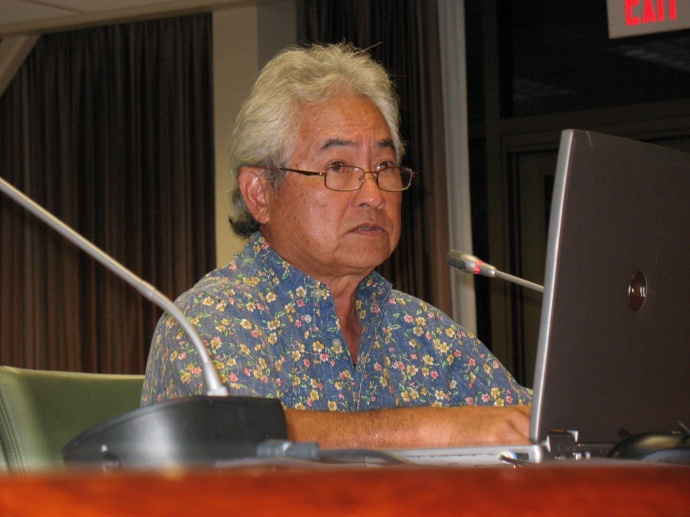
lloyd-haraguchi-public-land-development-corporation
A harried Lloyd Haraguchi tries to convince the Hawaii County Council not to vote in favor of a resolution calling for the dissolution of his agency. Photo by Dave Smith.
And Haraguchi, who appeared before the council to defend his agency, has not been spared the ire, as some of the public testimony as well as some private comments have been aimed at the agency’s appointed director.
At the Oct. 3 council meeting he was called “evil,” among other things, by Puna resident Aurora Martinovich, a frequent geothermal protester.
Following the council vote, she was observed following Haraguchi as he walked to his car in a parking lot a half-block away, obviously giving him a piece of her mind.
At one point Martinovich’s comments prompted Haraguchi to pull out his phone and call the police.
While she wouldn’t name names, a Hawaii Police Department spokeswoman has confirmed that a call for assistance was made at the time and place of the confrontation between Martinovich and Haraguchi, but when officers arrived, the caller declined to initiate a criminal complaint.
Although PLDC staff has acknowledged that a police report was generated, Haraguchi has refused to discuss it.

Wednesday, September 19, 2012

Geothermal Drilling Bill Heads to Council

By ERIN MILLER
Stephens Media

The sound of Puna Geothermal Venture’s turbines is akin to a train or jet engine running all the time, Pahoa resident Paul Kuykendall told a Hawaii County Council committee Tuesday morning.

“Even the coquis are preferable to the industrial sound coming from the plant,” he said, during testimony in front of the Agriculture, Water and Energy Sustainability Committee. And the drilling that took place earlier this year was even louder, Kuykendall said.

Council Chairman Dominic Yagong introduced Bill 292 to limit geothermal drilling to daytime hours, from 7 a.m.-7 p.m. The committee sent the bill to the full council with a positive recommendation.

Hilo Councilmen Donald Ikeda and Dennis Onishi provided the only dissenting votes.

PGV Manager Mike Kaleikini said the plant has been operating within its noise limits. He testified against the bill, noting that even if drilling were halted at night, some of the equipment would have to stay running, generating noise even if nothing was being drilled. “To limit drilling to daytime hours only, the drilling process itself could be prolonged as much as two to three times longer,” he added.

Kuykendall, who testified just after Kaleikini, said he would prefer a longer drilling period, if it meant quieter nights.

About 15 people testified in support of the bill.

South Kona Councilwoman Brenda Ford said the bill may be the result of Yagong’s experiences hearing the geothermal drilling at PGV, but the bill isn’t specific to that company.

“There’s going to be geothermal drilling in Kona,” Ford said. “Everything going on in Puna that’s a detriment to the community is going to go on in Kona around Hualalai. It is a generic policy issue that this council has the legal right and obligation to pass to protect the public.”

Ikeda questioned Deputy Corporation Counsel William Brilhante on whether the measure oversteps the county’s authority. Brilhante said PGV historically has complied with state and county limitations on noise levels. He was concerned about the council making changes to the county charter that conflict with PGV’s permitting conditions and requirements.

“This proposed bill is saying, ‘You know what? We don’t care what that permit does. We don’t care historically what has been done,’” he said. “’We’re going to make you comply with more requirements that are stricter than what was required under the original permit.’”

Planning Director Bobby Jean Leithead Todd submitted a letter Tuesday morning to the committee expressing similar concerns, North Kona Councilman Angel Pilago said.

Yoshimoto asked for a formal opinion from corporation counsel on the bill, but voted to advance the measure to the full council with a favorable recommendation.

More than a dozen people testified, their testimony expanding on the drilling noise issue to sound levels from daily plant operations.

Kaleikini said the plant can impose more mitigation measures to limit sounds.

Bob Ernst, testifying from Hilo, said he supported the bill because sound from the plant should not be intruding in nearby residents’ homes.

“Noise pollution is not pono,” Ernst said.

Email Erin Miller at emiller@westhawaiitoday.com.

Saturday, July 14, 2012

Mayor Vetoes Geothermal Bills

Hawaii County Mayor Billy Kenoi
By PETER SUR
Tribune-Herald staff writer

A pair of bills relating to geothermal energy have died on Mayor Billy Kenoi’s desk, unless the County Council can engineer an override of the veto. Both bills generated tremendous public testimony prior to their passage by the County Council last month. Kenoi’s veto messages described both as unnecessary legislation.

One bill would have required the county Civil Defense Agency to prepare an emergency response and evacuation plan for geothermal facilities and to submit it to the County Council for approval by Aug. 1. The bill is aimed at people living near Puna Geothermal Venture. The bill would have allowed the administration to ask for a 90-day extension to write the plan.

Kenoi’s veto message for the Civil Defense bill states that first responders already have a plan for all emergency situations, including geothermal, based on the Federal Emergency Management Agency-developed incident command system.

“Since effective plans are already in place, there is no need for a new plan,” Kenoi wrote.
Council Chairman Dominic Yagong, who introduced both bills, said he was disappointed with the mayor’s action.

“In my estimation, that’s playing politics with people’s lives,” he said.

Councilwoman Brenda Ford said residents of lower Puna should have an idea of what to do in the event of a geothermal mishap.

“The community needs a plan on what to do, and they need guidance from the county on how to respond to a disaster,” he said. “You know, Plan A, Plan B, Plan C. That has not occurred, and I am supportive of that type of community evacuation plan being designed by the county and delivered to all the residents so that they know what to do.”

Ford said the county uses its incident command system “beautifully,” but “the average citizen hasn’t a clue what to do.”

A community evacuation plan would help in that situation, she said.

The other vetoed bill, which would affect people in lower Puna, would have renamed the Geothermal Relocation and Community Benefits Program to the Geothermal Relocation and Public Safety Program, although it’s popularly known as the “geothermal royalties” fund.

This bill would have redirected money from the community benefits program into uses that relate to public health and safety, including air quality monitoring and a public notification system. It would also have made eligible for relocation all homes within a mile of Puna Geothermal Venture.

“The thought that the county would not let us use money to determine what is making these people ill is the most egregious, lack of concern and compassion I have ever heard of,” Ford said. “These people are not making up these illnesses.

“Now, I do not know what is causing it,” Ford said. “They’ve got problems and nobody’s looking at it. … They’ve got very unusual illnesses.

Kenoi’s message to the council says the bill duplicates the purpose of the $2.1 million Geothermal Asset Fund, which is dedicated to funding public health and safety mitigation measures.

Kenoi also wrote that a “significant number” of people who have seen community benefits from PGV would like to see those benefits continue. But Ford said there were “far more people” who supported the bill than opposed it. She pegged the number of supporters at 60 to 70 percent of those who testified.

Kenoi wrote that the bill would result in lower tax revenues for Hawaii County by acquiring and holding homes from people who wish to be relocated, and liability issues that would arise from those vacant homes.

“It would be irresponsible for me to sign (the bill) into law due to its legal and technical flaws and because it is unnecessary,” Kenoi wrote.
But his critics think otherwise.

“Is he saying that health studies are inappropriate? Is he saying that the people of Puna are making these stories up?” Yagong asked.

Kenoi said that’s not the issue.

“The goals of protecting public health, safety and doing a thorough, comprehensive health study, we can already achieve through existing legislation and authority,” he said, and said the county was going to conduct a “thorough, open, transparent and community-involved study with health care professionals, independent researchers who have already inquired. … We’ll go to the community to address those goals.”

“We don’t believe this legislation is based on good science, good authority,” Kenoi wrote. “There’s too much ambiguity, and the first hurdle in signing any piece of legislation is a good law. And unfortunately this legislation has too many flaws.”

The County Council approved the evacuation plan bill by a 7-2 vote and the relocation and public safety bill by a 6-3 vote. Yagong has not indicated whether he would call for a veto override.

Email Peter Sur at psur@hawaiitribune-herald.com.

Source: Hawaii Tribune Hearld