Showing posts with label Big Island. Show all posts

Saturday, November 10, 2012

HELCO Drafts RFP to Expand Geothermal on Hawaii Island

The electric utility on Hawaii island published Friday the first draft of a plan to add 50 megawatts of geothermal power to the island's electric grid.

Hawaii Electric Light Co. will seek public comment on the draft to help guide renewable energy developers as they prepare their bids to supply geothermal power to HELCO. A final draft of the document is scheduled to be completed by January, and selection of the winning bidder or bidders is expected by July or August.

An existing 38-megawatt geothermal plant on Hawaii island already accounts for about 20 percent of the island's peak electrical load. An additional 50 megawatts would push the amount of geothermal generation to nearly 50 percent of peak load.

"This project combines our efforts to increase renewable resources on our island with a commitment to reduce costs for consumers," HELCO President Jay Igna­­cio said.

HELCO customers pay among the highest electricity rates in the state.

HELCO plans to conduct a technical conference webi­nar next month to allow prospective bidders to ask questions and provide comments on the draft document, known as a request for proposals, or RFP.

The contracted price HELCO will pay developers for the geothermal energy will not be linked to the cost of oil, as is the case with many of the other renewable energy projects on Hawaii island.

"This is incredibly important for ratepayers on the Big Island," said Lt. Gov. Brian Schatz. "This will help stabilize prices. What people on the Big Island need is clean, affordable energy, and that's the purpose of this RFP."
One of the keys to making the plan work is engaging the community, he added. "We are working hard to have it done right, respecting the environment and the culture," Schatz said.

Bringing another 50 megawatts of geothermal power online will pave the way for the eventual retirement of fossil fuel-burning electrical generators on Hawaii island, he said.

More than 40 percent of the electricity consumed on Hawaii island is generated from renewable resources, the highest percentage of any island in the state. Besides geothermal, Hawaii island has hydroelectric, wind and distributed solar power generation.

SOURCE: Star Advertiser (11/10/2012)

Sunday, September 23, 2012

Kenoi, Kim Outline Differences at Friendly Mayor's Race Forum

HILO, BIG ISLAND (HawaiiNewsNow) -
Billy Kenoi and Harry Kim have known each other for decades. Kim coached Kenoi when Kenoi was just eight years old. And Kenoi was Kim's executive assistant when Kim was mayor. So it was a friendly matchup when the two candidates for Hawaii County Mayor met Friday in a candidates forum at the University of Hawaii-Hilo.

One of the topics at the forum was what to do with the island's trash as the Hilo Landfill nears capacity. Mayor Kenoi pointed to Oahu's H-Power facility as something that Hawaii County can emulate.

"They (Oahu) have four times as much trash as we do, over a thousand tons. They generate over 50 megawatts of energy that powers over 40,000 homes, and they do it for a cost of 91 dollars per ton," said Kenoi.

"Whether waste to energy will be the solution here, I don't know," said former mayor Kim. "It may be something we'll pursue, but we will pursue alternatives besides a landfill."

Perhaps the most pointed disagreement between the two had to do with Community Development Planning on the Big Island, a program started by Kim when he was mayor.

"By law, government will work with the public to determine their lifestyle and the future of their land," said Kim. "I think it's very important that we do this, by ordinance, by law. I was not happy with this administration not fully embracing it."

Kenoi countered that his administration has started even more community development plans several Big Island districts. But, he added, "Community development plans are important because they give the community meaningful input. But they do not supersede community services that everybody expects every day."

Both candidates also came out in support of geothermal energy, but with close government oversight.

"I am here to support geothermal," said Kim. "I am here to tell you we must do it safely like California does it. We must enforce rules and regulations and not depend on the private industry to tell you what the situation is in regards to public safety."

"Currently we have 38 megawatts being produced," said Kenoi about Puna Geothermal Venture's plant. "A lot of fear and questions are going around that there will be a thousand megawatts and industrialization of Puna. And the politics of fear is the worst politics of all."

Copyright 2012 Hawaii News Now. All rights reserved.

Monday, July 16, 2012

Geothermal Bills Still Alive

By TOM CALLIS
After being vetoed last week, two geothermal bills will get another chance Thursday as the Hawaii County Council votes on whether to override Mayor Billy Kenoi’s administrative dismissal.
Both bills were the product of renewed opposition to Puna’s geothermal plant and questions over the safety of the technology.
The legislation partially re-purposes the county’s geothermal royalties fund to allow it to cover public safety programs related to the plant, and mandates an emergency response plan for existing and future plants
In his veto message, Kenoi said the bills are unnecessary since it would duplicate the purpose of another geothermal fund and because the Big Island’s incident command system would cover a geothermal disaster. He also expressed concern with one of the bills preventing the county from selling homes it acquires through the geothermal relocation program.
County Council Chairman Dominic Yagong, who introduced the bills, said the move snubs the dozens of Puna residents who have called on the county to do more to ensure the nearly 20-year-old plant has no impact on health and safety.
He called the veto political (Yagong is one of Kenoi’s main challengers in this year’s election) and expects a large turnout of bill supporters at the meeting. Six votes are needed to overturn a veto.
“I truly believe that these bills were correct and we’re going to do our darnedest to make sure we do have our six votes,” Yagong said.
Kenoi did not return a request for comment by press time.
Recent council meetings have turned into marathon public comment sessions with Puna residents, both for and against the bills, speaking for hours to the council.
Pele Defense Fund President Palikapu Dedman said his group stands by the bills and will make its support known inside and outside the council chambers.
Dedman said PDF members will join geothermal opponents in testifying before the council and picketing that same day outside the county’s Hilo offices and possibly and state Department of Health building on Kamehameha Avenue.
“We’re bringing all that we can,” he said, adding that group members will also present Kenoi with a list of their concerns.
Dedman said he hopes to see at least 100 people picketing.
Thursday’s meeting will be held in Kailua-Kona, but those unable to make the trip can still speak to the council via videofeeds in Pahoa, Hilo and Waimea.
Dedman said he expects a lot of geothermal opponents and other supporters of the bills to testify from the windward side.
After spending hours testifying in past meetings, he doesn’t expect too many of them to be happy.
“After all those hours and days of testimony … with one stroke of the pen he shuts everybody off,” Dedman said. “That’s pretty bad.”
The geothermal bills aren’t the only legislation Yagong is seeking to revive.
The council will also consider on Thursday overriding Kenoi’s veto of a bill that Yagong introduced requiring the county to make payments into a county retiree benefits account.
Kenoi called the bill “ill-conceived” and “fiscally irresponsible.”
The county is deferring the payments, which the administration says prevents the county’s fund balance from being drawn down to unacceptable levels that would threaten its bond rating.
Email Tom Callis at tcallis@hawaiitribune-herald.com.

Wednesday, June 27, 2012

Pohoiki and Kalapana Community Planning Meeting

All residents from Kalapana to Pohoiki are invited to meet July 22, 2-4pm at Uncle Robert’s in Kalapana.
The meeting will introduce a survey to collect the viewpoints of all residents.
Kalapana-Pohoiki Neighborhoods Organization (KAPONO)

Kalapana to Pohoiki Community Input Survey
Presented by the Steering hui of the Kalapana-Pohoiki Neighborhoods Organization (KAPONO).

NOTE: The survey is directed to only those that own or rent along 137 between Kalapana to Pohoiki.

KAPONO Mission Statement: KAPONO is a community-directed organization that welcomes community members from Kalapana to Pohoiki to join together with local government, businesses, organizations, and individuals for the protection and enhancement of the health, heritage and safety of our communities: our homes, our ‘ohana, and our lifestyles.

Goal of Survey – Development of a Long Range Community Plan that gives us a voice in our future

KAPONO first meeting was in July 2011 and now after a year of meetings and hard work, we are organized and excited to present a Community Input Survey. Much of the survey elements are taken from the Puna Community Development Plan** (PCDP), to gain input as to what is important to our community and also guide the priority of implementation.

All responses will be tabulated and presented at a community meeting at the end of September.

Please come and meet July 22, 2-4pm at Uncle Robert’s in Kalapana. — Richard Koob

Source: PUNA NEWS: Big Island Chronicle

Sunday, June 17, 2012

Two Geothermal Bills Move Forward on Big Island


By Leslie Blodgett, GEA
June 13, 2012

Thursday, June 7, 2012

Hawaiian Electric Industries Deregulation Issues


Presentation to educate the people of Hawaii and others about the 100 year old utility monopoly that has a stranglehold on Hawaii's energy future, operates with full impunity or carte blanch, and rules this state like an outlaw gang in an old west town of the 1880's.

Wednesday, June 6, 2012

Council to Mull Geothermal Buffer Zone

The full impact of a bill to create a buffer zone around Puna Geothermal Venture’s plant remains to be seen, county officials said Monday.
Bill 256, proposed by Council Chairman Dominic Yagong, goes before the full council Wednesday in Hilo for first reading. Yagong said the bill is the first step in dealing with the potential health ramifications of living so close to the geothermal energy production plant, although it could also have impacts, in the future, on people living in other parts of the East Rift Zone.
“The real key is, we need to take care of the people around the plant first,” Yagong said, adding that whether the buffer zone should extend farther into the rift zone is a good question. “We can go and expand it even farther from there (the proposed one-mile buffer).”
One thing the county cannot do, he added, is force people to leave their homes, even in a buffer zone.
Yagong’s proposal would move responsibility for the geothermal royalty funded Geothermal Relocation and Community Benefits program, which would be renamed the Geothermal Relocation and Public Safety Program, from the Planning Department to Civil Defense. Bill 256 would also allow spending relocation money for health studies, Yagong said.
Yagong said it would be up to Civil Defense to decide whether to conduct health impact studies before relocating residents. Civil Defense Director Ben Fuata was out of the office Monday. Mayor Billy Kenoi did not immediately respond to a message left Monday afternoon.
Planning Director Bobby Jean Leithead Todd said Yagong’s bill is “superfluous,” because the county already has the authority to spend the royalty money to relocate residents.
Homeowner relocation requests have increased significantly — from two between 2005 and 2011, to seven in the last few months — after the County Council began debating the bill, she added.
The existing program does give priority to people who have owned the house since before 1991, she said, but anyone living within that radius may apply for the program.
The department continues to issue permits, she said, because not doing so might be construed as the county taking an owner’s property.
Leithead Todd said one change to the existing relocation program she’d like to see in place is the ability for the county to purchase vacant land adjacent to the plant. Doing so would create a better buffer and would be cheaper than just buying homes.
“If I’ve got to buy the house at 130 percent of real property appraisal, that’s a lot more money,” Leithead Todd said.
Officials with Puna Geothermal Ventures’ owner, Ormat Technologies, expressed concerns about the bill Monday, through Policy and Business Development Director Paul Thomsen. Thomsen provided West Hawaii Today with a letter, being provided to community members, explaining the technology used within the plant, including the reinjection of the brine heated to create the steam that powers the turbines.
“PGV must operate under stringent air emission, water quality and noise standards set forth by the Hawaii Department of Health and Environmental Protection Agency,” Thomsen wrote. “In doing so, PGV continually monitors (hydrogen sulfide) through 35 point-source detectors placed throughout the power plant. PGV also maintains three monitoring stations that are located on the perimeter of the facility. These stations monitor meteorological and noise data, which can be viewed on the company website and is provided in a formal report given to the (Health Department) on a monthly basis, or as requested. For over 20 years, PGV has complied with state-mandated emissions standards.”
PGV also submitted a letter to Agriculture, Water and Sustainability Committee Chairman J Yoshimoto, requesting time to discuss the plant’s safety protocols and respond to the community’s concerns.
Thomsen said he sees bigger issues facing Puna residents than PGV, particularly naturally occurring pollution of water as it flows from Mauna Loa through the East Rift Zone, picking up chemicals from magma along the way.
“So the fresh water aquifer between the East Rift Zone and the ocean, from Volcano to Kapoho does not meet EPA drinking water standards,” Thomsen said. “This is a natural process that has been going on for millennia and is the source of the warm ponds along the coast from Kapoho to Kalapana. … Natural emissions from the rift in the Puna District are much greater than any potential emissions from PGV.”
He noted a 1998 Department of Health study that found no adverse health impacts from living near the plant.
The council on Wednesday also takes on the first reading of another Yagong measure, this one to ban aerial game hunts in Hawaii County. Bill 261 “declares that the acts of eradication by aerial shooting on this island shall no longer be practiced, and ensures that other methods of animal population control are utilized.”
Mainland magazine Outdoor Life ran an article online last week urging hunters to contact Yagong and tell him they opposed aerial hunting.

Tuesday, June 5, 2012

Harry Kim to File for Mayor

By Dave Smith - June 4, 2012
Source: Big Island Now
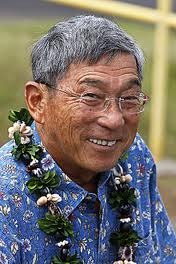
Harry Kim, above, has decided to run again for Hawaii County mayor. Wikipedia photo.
Former two-term mayor Harry Kim today took out nomination papers to run for the chief executive position on the Big Island.

Kim told Big Island Now this afternoon that he will definitely file to run for mayor tomorrow, which is the election deadline for the Aug. 11 primary election.

Kim’s candidacy adds a significant twist to the mayor’s race where he will become the 10th candidate, according to Friday’s report from the state elections office.

Those with the highest profiles, incumbent Mayor Billy Kenoi and County Council Chairman Dominic Yagong, could not be immediately reached for comment.

Kim, 72, served as mayor from 2000-2008 after a 24-year stint as director of the county’s Civil Defense Agency. He was prevented by term limits from running for re-election immediately after that.

Kim knows his chief opponents well.

Yagong ran against him for mayor in the 2004 nonpartisan primary where he received 26% of the vote to Kim’s 62%. Kim has known Kenoi for many years and coached him as a player on the Waiakea High School football team. Kenoi also served as an executive assistant in the last six years of Kim’s administration.

Kim said he didn’t have qualms with either candidate who he said have a “different style of management” from him. Kim had endorsed Kenoi’s bid for mayor in 2008.

Kim said today that his return to politics was largely driven by actions that occurred during the past session at the state Legislature dealing with geothermal development.

He said he was disheartened by the easing of restrictions for those activities including the removal of the requirement for subzones for geothermal development.

But what prompted him into direct action, Kim said, was a request from DLNR Director William Aila Jr. to the state Environmental Council. Aila had asked the panel to exempt exploratory geothermal drilling from the state law that mandates the preparation of an environmental assessment or the more rigorous environmental impact statement.

Kim said he was dumbfounded when a committee of the council voted almost unanimously to recommend approval of Aila’s request.

“I couldn’t believe (the committee) did this,” Kim said. “I said, nah, they wouldn’t do that.”

After being urged to intervene by Gary Hooser, head of the state Office of Environmental Qualify Control, Kim spent four days researching the matter and preparing testimony.

After Kim appeared in person before the full Environmental Council in Honolulu, its members reversed the committee’s recommendation and voted to deny the change Aila had requested.

After that, “I really started thinking about geothermal, safety and health in government,” he said. “How could they do this?”

Kim said he also wondered how, if the exemption stood, government could justify requiring environmental studies for other types of projects.

Kim said his jaw dropped when he heard Aila say drilling for geothermal is comparable to drilling for water.

“I realize that some people truly think that geothermal is harmless,” he said. “I would think people in authority should do some research.”

Kim said he decided to re-enter politics to make sure geothermal and other development “is done right.”

“I realized that it’s not just about geothermal, it’s about faith in government,” he said.

Kim said another subject he is concerned about is solid waste. He said he has never been a proponent of landfills anywhere in Hawaii, and believes the solution is a plant like Oahu’s H-Power where garbage is burned to generate electricity.

He acknowledged that the waste-to-energy facility considered during his second term carried a steep price tag of $125 million, but feels that it’s the government’s duty to find a way to do it affordably.

He said he was also opposed to the County Charter amendment that set aside 2% of county revenues to purchase land to be preserved as open space, partly because it didn’t include funding for maintenance of those lands.

“That’s not a good way to spend public money,” he said, adding that such funding should be found elsewhere.

In the area of public funding, Kim will likely be subjected to questions about his administration’s practice of increasing the size of government during flush times, when soaring property values inflated county coffers.

During Kim’s eight years in office, the county’s operating budget more than doubled to more than $400 million. That included a tax increase of nearly 25% for homeowners sought by Kim and approved by the council for the 2002-03 fiscal year.

Kim said today he will run a campaign similar to his other two, in which he describes himself as an “applicant” for the mayor’s job.

While he has relatively little time for fundraising, that also includes continuing his policy of not taking any campaign donations greater than $10. Kim said no amount of advertising he could purchase would overshadow public perception of his years of public service.

“I worked for the people here for more than 40 years, and by now they should know me and my methods,” he said.

Kim acknowledged that his health could be an issue in the campaign, as he suffered two heart attacks in his final year in office.

“My health at this point is good,” he said, while acknowledging that he is currently undergoing additional cardiac testing.

He also admitted that because of the health issues his family did not want him to run, but supports his decision to do so.