Saturday, October 20, 2012

Public Protest Too Much For PLDC?

By Dave Smith
public-land-development-corporation-protest
A protest over the Public Land Development Corporation. Photo courtesy Hawaii News Now.
It looks like it will be try, … again for the Public Land Development Corporation.
The controversial new state agency designed to increase revenues from state lands using public-private partnerships is continuing its efforts to establish its administrative rules.
Following statewide hearings in August, the agency revised the guidelines and added a strategic plan.
The PLDC’s five-member board met on Thursday and voted to take the amended rules to public hearing.
However, only one of those is planned, on Nov. 13, and that will be on Oahu.
Lloyd Haraguchi, the PLDC’s executive director, was not available for comment on why other islands were not included in the schedule.
According to a statement from the PLDC, even though state law required only one hearing be held, the agency’s board of directors in August took the “extra step” of holding hearings statewide. The reason, it said, was to familiarize the public with the new state entity.
Now the PLDC says it will hold an additional public hearing on the amended rules, as required by law.
The rules can be viewed at hawaii.gov/dlnr/pldc, and “any member of the public may submit advance testimony via email or USPS mail by Tuesday, November 13,” the agency said.
“The PLDC remains committed to transparency, and its newly adopted strategic plan, project flowchart and rule amendments show that opportunities for public comment actually expand under the PLDC for potential projects,” the statement said.
But one can’t help but wonder if the primary reason for not taking the revised rules on the road is that the PLDC – and its director – have had their fill of the rough reception they received across the state.
The first time the agency took the draft rules out for public hearings, it encountered large and hostile crowds.
And recent public protests across the state drew hundreds of participants.
Sierra Club Chapter Director Robert Harris described the PLDC’s decision to hold only one public hearing a “new low” for the agency. He went on to say that Haraguchi was “insulting thousands of neighbor island residents by excluding them from the process.”
Much of the criticism has centered on a section of state law exempting the PLDC from “land use, zoning, and construction standards for subdivisions, development, and improvement of land.”
The mission of the PLDC has been called everything from a land-grab, to anti-democratic, to Nazi-ism.
Despite the revision of rules and addition of a strategic plan, county councils on the neighbor islands are all expected to unanimously pass resolutions seeking to abolish the Public Land Development Corp.
Nor did the changes soothe those testifying when the Hawaii County Council overwhelmingly approved its version of a resolution urging Gov. Neil Abercrombie to repeal Section 171C of Hawaii Revised Statutes — also known as Act 55, the law that created the PLDC.
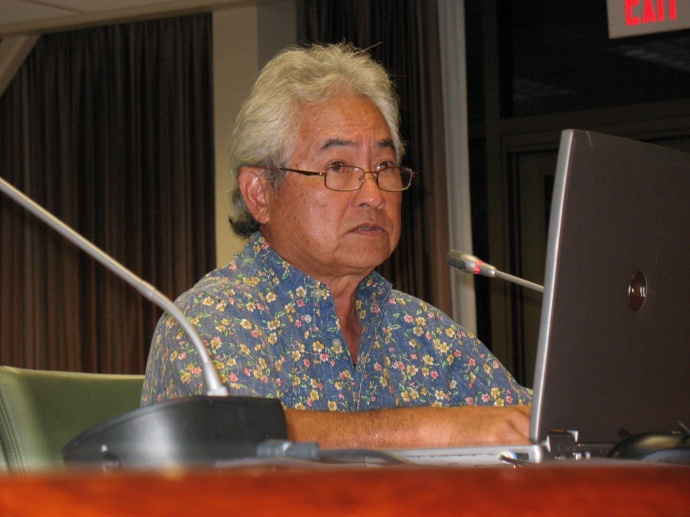
lloyd-haraguchi-public-land-development-corporation
A harried Lloyd Haraguchi tries to convince the Hawaii County Council not to vote in favor of a resolution calling for the dissolution of his agency. Photo by Dave Smith.
And Haraguchi, who appeared before the council to defend his agency, has not been spared the ire, as some of the public testimony as well as some private comments have been aimed at the agency’s appointed director.
At the Oct. 3 council meeting he was called “evil,” among other things, by Puna resident Aurora Martinovich, a frequent geothermal protester.
Following the council vote, she was observed following Haraguchi as he walked to his car in a parking lot a half-block away, obviously giving him a piece of her mind.
At one point Martinovich’s comments prompted Haraguchi to pull out his phone and call the police.
While she wouldn’t name names, a Hawaii Police Department spokeswoman has confirmed that a call for assistance was made at the time and place of the confrontation between Martinovich and Haraguchi, but when officers arrived, the caller declined to initiate a criminal complaint.
Although PLDC staff has acknowledged that a police report was generated, Haraguchi has refused to discuss it.

Thursday, October 18, 2012

Council to Hold Hearing for Nighttime Geothermal Drilling Ban

By TOM CALLIS
Stephens Media
tcallis@hawaiitribune-herald.com

A proposal to prohibit geothermal drilling at night ran into a snag Wednesday when the Hawaii County Council opted to hold a public hearing on the issue rather than take a final vote.

Hilo Councilman Donald Ikeda proposed the hearing, approved in a 5-3 vote, citing confusion over whether the nighttime ban would apply to Puna Geothermal Venture. Council members Fred Blas, Brenda Ford and Pete Hoffmann voted no.

The hearing, to be held in Puna on a yet-to-be-determined date, would follow two bill readings by the council and a positive recommendation from the council’s Agriculture, Water and Energy Sustainability Committee. Public testimony was taken at the three previous meetings, sometimes at length, from supporters of the ban as well as PGV representatives.

Ikeda said the hearing would allow PGV to better explain what it does to limit noise during drilling, as well as its “vested rights.” He also mentioned what he saw as a disconnect between some of the testifiers and how PGV runs its 38-megawatt plant, the only geothermal facility in the state.

“I don’t like to be the only dissenting vote, look like I don’t support the people,” Ikeda said before proposing the hearing. “I do, but I also believe Puna Geothermal has rights, too.”

A few council members said they believe the county’s legal staff determined that the bill couldn’t affect drilling at PGV since it already has a permit from the Windward Planning Commission for future drilling, and questioned the need for a hearing.

“I think I heard the Corporation Counsel clearly indicate it can’t be retroactive,” Hoffmann said.

“Therefore, I don’t see PGV related to this issue at all.”

Hilo Councilman Dennis Onishi said he had the same interpretation.

“I think people could misinterpret what could happen,” he said.

Hilo Councilman J Yoshimoto suggested the council adopt an amendment stating the bill doesn’t apply to PGV.

Council Chairman Dominic Yagong, who introduced the bill, said an amendment is not necessary, leading to it being dropped during discussion.

“I think the (executive) session we went through was quite clear,” he said. “I don’t think there is any confusion there.”

Deputy Corporation Counsel William Brilhante said he couldn’t comment on whether the bill would apply to PGV, citing potential liability.

Either way, the bill would still apply to new geothermal operations.

Brilhante said enforcement would be up to the county Planning Department.

Planning Director Bobby Jean Leithead Todd couldn’t be immediately reached for comment.

The bill was prompted by drilling at PGV earlier this year that some nearby residents said was too disruptive and caused them to lose sleep.

PGV Plant Manager Mike Kaleikini told the council he received about 45 complaints during drilling, lasting from March 1 to July 7.

That’s up from the four complaints during drilling in 2010, which he said was a few decibels louder.

Kaleikini said the plant uses insulation and a barrier wall to reduce noise.

It’s also considering adding another wall, he said.

Friday, October 5, 2012

Hawaiian Volcanos Observatory Scientists Say Geothermal Drilling Won't Cause Sinking

Kilauea Volcanic Rift Zones subside whether or not they host geothermal developments

Recently, Hawaiian Volcano Observatory scientist’s have been asked if Hawaii Island’s geothermal development causes subsidence of the ground surface, as has been observed at U.S. mainland geothermal areas, such as those in California– Coso, Geysers, the Imperial Valley, and Casa Diablo in the Mammoth Lakes area.

The largest of these mainland developments is heated by magma reservoirs that supplied eruptions through non-volcanic rock layers. The magma, thousands of years old, still heats groundwater within California’s sedimentary basins, where, fluid withdrawal during geothermal energy production can reduce pressure within the subsurface rock formations. When this happens, the ground surface subsides.

The highest subsidence rates are measured at the Geysers Geothermal Field within the Clear Lake Volcanic Field in northern California. The 78 square kilometer (30 sq mi) developed area produces 1,500 megawatts (MW) of electricity from a vapor-dominated reservoir within fractured sandstone that is capped by a zone of rock filled with geothermal minerals at the top and heated by magma below.

The Clear Lake volcanic field is one of several in California and Nevada that are monitored by HVO’s sister California Volcano Observatory (CalVO; http://volcanoes.usgs.gov/observatories/calvo/). CalVO also monitors the Long Valley caldera, in which the Casa Diablo geothermal development (40 MW) is located; the Salton Buttes volcano, which includes the Imperial Valley geothermal field (>300 MW); and the Coso Volcanic Field, where a 270 MW geothermal development is located.

As volcanic activity waxes and wanes, each of these areas exhibits its own deformation and seismicity. For example, the Long Valley caldera has experienced several episodes of heightened unrest, including earthquake swarms, ground uplift, and volcanic gas emissions during the past several decades. Thus, CalVO watches this area closely. The subsidence related to geothermal development must be documented carefully to separate the effects of volcanic activity from those due to drilling and energy production.

Tuesday, October 2, 2012

PLDC - Public Land Develompent Corp to Consider Rule Changes October 11

by Dave Smith

The Public Land Development Corp. will meet Oct. 11 in Honolulu to consider the approval of a strategic plan as well as some changes to its draft administrative rules.

The controversial new agency issued a statement Saturday night saying that it was posting notice of its next board meeting early – “well before the six-day notice” required by the state’s Sunshine Law — to give the public “ample time” to submit comments on the plan and rule amendments.

The statement said the proposed amendments to the PLDC’s operating rules will reflect the strategic plan and address concerns raised at public hearings held by PLDC Executive Director Lloyd Haraguchi on the draft rules across the state.

Testimony at the August hearing on the Big Island and elsewhere in the state was was overwhelmingly critical of the PLDC and its administrative rules.

Gov. Neil Abercrombie, who in 2011 signed Act 55, the state law authorizing the PLDC, was a recipient of some that ire on Kauai on Aug. 19. Although the agency’s public hearing there wasn’t scheduled until later in the month, Abercrombie, who had brought his cabinet for a talk-story session, was heckled and booed over the PLDC and its enabling legislation.

Part of the reason for Abercrombie’s treatment on Kauai could be attributed to comments he made several days earlier calling critics of the agency the “usual suspects” who took advantage of the hearings to create “conspiratorial hysteria.”

Some critics of the PLDC have called for the abolishment of Act 55. Those include Hawaii County Councilwoman Brenda Ford, who has introduced a non-binding resolution urging the Legislature to disband the PLDC.

Ford’s resolution will be taken up at a council meeting Wednesday in Hilo.

The PLDC was created, its backers say, to create public-private partnerships to generate badly needed revenues for the state Department of Land and Natural Resources from what they call underutilized state lands. Abercrombie has said that the public corporation has the ability to reduce government bureaucracy.

Critics of the agency have railed against vague wording in the draft administrative rules as well as the law exempting the agency from some state environmental laws as well as county zoning and subdivison regulations.

The backlash at public hearings also prompted Big Island state Sen. Malama Solomon to propose creation of a strategic plan to help dispel what she called “so much misinformation” about the corporation’s mission.

In Saturday’s statement, Kalbert Young, director of the state Department of Budget and Finance and the chairman of the PLDC’s Board of Directors, said the proposed changes will address “the issues – and many misconceptions – that have been raised” in public hearings.

“We have heard the concerns of the community, and the PLDC board will now consider adoption of a strategic plan to better define what the PLDC can and cannot do,” Young said.

The draft strategic plan is available on its website listing for items accompanying the agenda for the Sept. 20 meeting.

According to the agenda for the Oct. 11 meeting, proposed changes to the draft administrative rules include removal of a section which called for the agency’s delegation of authority to its administrator “as it deems reasonable and proper” to effectively carry out Act 55.

Another proposed change include deleting of a section requiring 20 days advance notice for public testimony on meeting agendas and a requirement that the agency maintain a list of persons requesting notification of board meetings.

A proposed addition would limit testimony at PLDC meetings to subjects on the agenda and allow its administrator to limit the amount of time allowed each testifier.

The amendments include removal of the words “development” and “developer,” which in some cases are replaced by “project” and “project partner,” respectively.

The Oct. 11 meeting agenda and proposed changes to administrative rules is available at http://hawaii.gov/dlnr/pldc/meetings.

Testimony can be submitted by email to Joy Kimura at joy.y.kimura@hawaii.gov or faxed to 808-587-0390.

Source: Big Island Now

Monday, September 24, 2012

Lowering the Balance of Power? HELCO Wants to Renegotiate its Power Purchase Agreements with Renewable Energy Providers

HILO — Hawaii Electric Light Co. wants to renegotiate its power purchase agreements with renewable energy providers.

Earlier this week, the County Council approved by a 9-0 vote a resolution urging HELCO to renegotiate its contracts based on the price of energy production rather than “avoided cost,” which ties the cost of producing renewable energy to the price of oil on the market.

“We are in agreement with the resolution,” said HELCO President Jay Ignacio on Friday. He testified in favor of the renegotiated contracts when the resolution came before a County Council committee.

Councilman J Yoshimoto said the idea for the resolution came out of a discussion about general energy issues with HELCO officials earlier in the year.

Last December, the Public Utilities Commission approved an amended purchase power agreement between HELCO and PGV to purchase an additional 8 megawatts of power that would expand production to 38 megawatts and provide monthly savings of between $1.60 and $1.90 per customer through 2025.

Those savings struck a lot of people as not enough, given Hawaii Island’s reliance on imported fuel for energy.

“The savings that resulted out of the recent negotiations that HELCO had with PGV were minimal,” Yoshimoto said. That’s why he wrote the resolution to “ask both parties to go back to the negotiating table. That’s the bottom line.”

Ignacio was hopeful PGV was looking to renegotiate at least one of its contracts.

“They (PGV) have approached us and asked to renegotiate the part of the contract governing the first 25 megawatts, and they recognize the problem,” Ignacio said. “We have sent invitations to all the other power producers inviting them to come back and negotiate the energy contracts.”

As stated in the resolution, HELCO will provide the County Council an update on the status of its efforts at its meeting Oct. 17 at the West Hawaii Civic Center. This update will include whether PGV “was amenable to lowering the price rates for payers and the amount of the new negotiated price, if one has been agreed upon.”

Yoshimoto said he was hopeful the negotiations result in savings.

Ignacio, interviewed separately, agreed.

“I do hope so,” the HELCO president said. “From the electric utility’s perspective, we want to get lower cost contracts so we can pass the savings on to consumers.”

“The only assurance that we have is that they negotiate in good faith,” Yoshimoto said.

Hawaii County residents pay some of the highest costs per kilowatt in the nation.

While the Legislature has passed a law mandating that future energy contracts be decoupled from the price of oil, that doesn’t help the existing long-term contracts, some of which are for 20 or 30 years, that rely on the avoided-cost model.

HELCO also has purchase power agreements with two wind farm firms, Apollo Energy Corp./Tawhiri Power LLC and enXco/Hawi Renewable Development; and hydroelectric plant Wailuku Holding Co.

Source - Hawaii Tribune Herald

Sunday, September 23, 2012

Kenoi, Kim Outline Differences at Friendly Mayor's Race Forum

HILO, BIG ISLAND (HawaiiNewsNow) -
Billy Kenoi and Harry Kim have known each other for decades. Kim coached Kenoi when Kenoi was just eight years old. And Kenoi was Kim's executive assistant when Kim was mayor. So it was a friendly matchup when the two candidates for Hawaii County Mayor met Friday in a candidates forum at the University of Hawaii-Hilo.

One of the topics at the forum was what to do with the island's trash as the Hilo Landfill nears capacity. Mayor Kenoi pointed to Oahu's H-Power facility as something that Hawaii County can emulate.

"They (Oahu) have four times as much trash as we do, over a thousand tons. They generate over 50 megawatts of energy that powers over 40,000 homes, and they do it for a cost of 91 dollars per ton," said Kenoi.

"Whether waste to energy will be the solution here, I don't know," said former mayor Kim. "It may be something we'll pursue, but we will pursue alternatives besides a landfill."

Perhaps the most pointed disagreement between the two had to do with Community Development Planning on the Big Island, a program started by Kim when he was mayor.

"By law, government will work with the public to determine their lifestyle and the future of their land," said Kim. "I think it's very important that we do this, by ordinance, by law. I was not happy with this administration not fully embracing it."

Kenoi countered that his administration has started even more community development plans several Big Island districts. But, he added, "Community development plans are important because they give the community meaningful input. But they do not supersede community services that everybody expects every day."

Both candidates also came out in support of geothermal energy, but with close government oversight.

"I am here to support geothermal," said Kim. "I am here to tell you we must do it safely like California does it. We must enforce rules and regulations and not depend on the private industry to tell you what the situation is in regards to public safety."

"Currently we have 38 megawatts being produced," said Kenoi about Puna Geothermal Venture's plant. "A lot of fear and questions are going around that there will be a thousand megawatts and industrialization of Puna. And the politics of fear is the worst politics of all."

Copyright 2012 Hawaii News Now. All rights reserved.

Friday, September 21, 2012

Governor Urges Plan for Hawaii Public Land Agency

By Associated Press

HONOLULU (AP) - The governor is urging a newly formed Hawaii public land Agency to adopt a plan defining its priorities and scope in an effort to address public criticism.

Critics say the Public Land Development Corp. would favor development because of its broad exemption from zoning laws. The agency was created by the State Legislature to allow for private development on state land.

The Honolulu Star-Advertiser reported Friday Governor Neil Abercrombie wrote to the corporation's board that adopting a strategic plan would show they are listening to the public's concerns.

The plan would make it clear the corporation has to comply with the state's environmental review and other laws.

Corporation board Chairman Kalbert Young says the board wants to wait until next month's meeting before deciding how to proceed.

Wednesday, September 19, 2012

Geothermal Drilling Bill Heads to Council

By ERIN MILLER
Stephens Media

The sound of Puna Geothermal Venture’s turbines is akin to a train or jet engine running all the time, Pahoa resident Paul Kuykendall told a Hawaii County Council committee Tuesday morning.

“Even the coquis are preferable to the industrial sound coming from the plant,” he said, during testimony in front of the Agriculture, Water and Energy Sustainability Committee. And the drilling that took place earlier this year was even louder, Kuykendall said.

Council Chairman Dominic Yagong introduced Bill 292 to limit geothermal drilling to daytime hours, from 7 a.m.-7 p.m. The committee sent the bill to the full council with a positive recommendation.

Hilo Councilmen Donald Ikeda and Dennis Onishi provided the only dissenting votes.

PGV Manager Mike Kaleikini said the plant has been operating within its noise limits. He testified against the bill, noting that even if drilling were halted at night, some of the equipment would have to stay running, generating noise even if nothing was being drilled. “To limit drilling to daytime hours only, the drilling process itself could be prolonged as much as two to three times longer,” he added.

Kuykendall, who testified just after Kaleikini, said he would prefer a longer drilling period, if it meant quieter nights.

About 15 people testified in support of the bill.

South Kona Councilwoman Brenda Ford said the bill may be the result of Yagong’s experiences hearing the geothermal drilling at PGV, but the bill isn’t specific to that company.

“There’s going to be geothermal drilling in Kona,” Ford said. “Everything going on in Puna that’s a detriment to the community is going to go on in Kona around Hualalai. It is a generic policy issue that this council has the legal right and obligation to pass to protect the public.”

Ikeda questioned Deputy Corporation Counsel William Brilhante on whether the measure oversteps the county’s authority. Brilhante said PGV historically has complied with state and county limitations on noise levels. He was concerned about the council making changes to the county charter that conflict with PGV’s permitting conditions and requirements.

“This proposed bill is saying, ‘You know what? We don’t care what that permit does. We don’t care historically what has been done,’” he said. “’We’re going to make you comply with more requirements that are stricter than what was required under the original permit.’”

Planning Director Bobby Jean Leithead Todd submitted a letter Tuesday morning to the committee expressing similar concerns, North Kona Councilman Angel Pilago said.

Yoshimoto asked for a formal opinion from corporation counsel on the bill, but voted to advance the measure to the full council with a favorable recommendation.

More than a dozen people testified, their testimony expanding on the drilling noise issue to sound levels from daily plant operations.

Kaleikini said the plant can impose more mitigation measures to limit sounds.

Bob Ernst, testifying from Hilo, said he supported the bill because sound from the plant should not be intruding in nearby residents’ homes.

“Noise pollution is not pono,” Ernst said.

Email Erin Miller at emiller@westhawaiitoday.com.

Saturday, September 8, 2012

Geothermal Talk at Hawaii Volcanoes National Park Sept. 25

Harnessing geothermal energy from Kilauea will be the focus of a talk on September 25 at Hawaii Volcanoes National Park. Photo courtesy of Hawaii Volcanoes National Park.
by Denise Laitinen

“Developing Energy from an Active Volcano” will be the focus of a talk at the Hawaii Volcanoes National Park in the Kilauea Visitor Center Auditorium on Tuesday, September 25, at 7 p.m.

The lecture, which is part of the Park’s monthly After Dark in the Park program series, is free but park fees may apply.

Hawaii Volcanoes Observatory scientists Jim Kauahikaua, Frank Trusdell, Wes Thelen, and Jeff Sutton will present a brief history of geothermal development in Hawaii and a description of the location and nature of the hydrothermal system.

The most attractive area for power development is Kilauea’s lower east rift zone. The scientists will address the volcano and seismic hazards on Kilauea and the effects of geothermal development, plus the volcanic gas emissions from the hydrothermal system and their potential hazards.

For more information, contact Jessica Ferracane, Hawaii Volcanoes National Park Public Affairs, 808-985-6018.

Friday, September 7, 2012

Council Tries to Bring Down Cost of Power

Posted on September 5th, 2012
by Dave Smith

A County Council resolution urging Hawaii Electric Light Co. to seek lower power costs from renewable energy providers — hopefully to be passed on to consumers — brought out enthusiastic supporters today.

The measure introduced by Hilo Councilman J Yoshimoto asks HELCO to renegotiate its contracts with independent power producers to “de-link” the power from avoided cost, or what it would have cost to generate the power with fossil fuels.

The concept of avoided cost was established by the Public Utility Regulatory Policies Act of 1978 as an incentive for development of sources of renewable energy. The federal law contained a provision that states could opt out of the program, which Hawaii did in 2006.

Currently, only 13 megawatts of the renewable-source electricity HELCO buys is not tied to avoided cost. That includes a contract recently established for an 8-megawatt expansion of Puna Geothermal Venture and a renegotiated price for 5 megawatts of the 30 megawatts already being provided by PGV.

HELCO President Jay Ignacio responds to questions about the utility’s electrical rates. Photo by Dave Smith.
HELCO has declined to reveal its specific power costs, but the company’s president, Jay Ignacio, told Big Island Now that the impact on residential power bills from the new contracts would be negligible.

According to Yoshimoto’s resolution, which passed unanimously, HELCO estimates that PGV’s 8-megawatt expansion under the lowered cost will reduce a typical residential electricity bill by $1.67 in 2015.

Earlier this year HELCO officials signed another de-linked contract, this one with Hu Honua Bioenergy to provide 21.5 megawatts to be generated by the burning of biomass at the former Hilo Coast Processing Co. sugar mill in Pepeekeo. Hu Honua isn’t expected to begin producing power until 2014 at the earliest.

During a meeting of the council’s Committee on Agriculture, Water & Energy Sustainability that ran well into the night, all of the testimony was in support of Yoshimoto’s resolution, although most of those speaking said it did not go far enough.

Kuulei Cooper of Pohoiki testified that the resolution would be “only a suggestion” and didn’t go far enough to break what she called HELCO’s “egregious monopoly.”

Wallace Ishibashi, a negotiator for the International Longshore and Warehouse Union, told council members that electricity prices must come down. He said it affects workers because their employers pay so much for power.

HELCO’s residential rates, currently about 43 cents per kilowatt hour, are often the highest in the nation.

“This is too much,” Ishibashi said. “They’re not going to take it anymore.”

Mililani Trask, a principal in Indigenous Consultants, an organization seeking to develop geothermal energy sources to benefit indigenous peoples, described the previous contract between Hawaiian Electric Co. and Ormat Technologies, owner of PGV, as “price-fixing.”

Trask suggested requiring that the resolution be amended to require that HELCO report back on its efforts to renegotiate contracts.

Yoshimoto later noted that while the Public Utilities Commission approved the 8-megawatt and 5-megawatt deals, it criticized HELCO and PGV for failing to extend the de-linking to the remaining 25 megawatts.

He said the PUC seemed resigned to the result, but the public need not be, and he hoped his resolution would encourage it to speak out.

“I think change starts with the people,” he said.

Yoshimoto noted that rates are established by contracts over which the council has no power. But, he said, just because the companies can make their own deals, that “doesn’t make it right.”

Yoshimoto’s resolution notes that HELCO contracts with three other companies providing power from wind and hydroelectric facilities remain based on avoided costs.

Councilwoman Brenda Ford expressed doubt that reducing the cost of power to HELCO would translate into much in the way of lower consumer bills.

Independent producers using both renewable resources and oil currently produce about 130 megawatts to HELCO, representing a little under half of the utility’s total power capacity.

HELCO President Jay Ignacio told council members that his company doesn’t make any profit from independent power producers. He said HELCO makes profits on its investments including utility infrastructure.

Ignacio said he is agreement with the resolution and his company has already attempted to renegotiate existing contracts. He said HELCO is currently in talks with PGV at that company’s request.

“That’s good news,” Yoshimoto said. He asked if any details could be provided, but Ignacio said the process has to be confidential.

Ignacio said the existing contract with PGV for the remaining 25 megawatts expires in 2027, and existing contracts with other renewable energy producers run for either 20 or 30 years.

In addition to the roughly 40 megawatts that HELCO obtains from geothermal, wind and hydroelectric power, the utility receives about 17 megawatts in solar power, most from homes or businesses that use net metering to reduce their individual energy bills.

Ignacio said HELCO’s efforts to obtain power from producers such as Hu Honua, as well as its current plan to obtain another 50 megawatts from geothermal, is designed to reduce HELCO’s dependence on oil and its volatile pricing. Increases in the price of oil can raise electricity bills through PUC-approved surcharges.

“If we can drive that down, that will really help our customers out,” he said.

Council Chairman Dominic Yagong successfully introduced an amendment to the resolution similar to Trask’s suggestion which asked that HELCO appear before the council at its Oct. 17 meeting to report on its progress in renegotiating with PGV.

Ignacio said his company would be willing to provide the update, but would still have to maintain confidentiality.

“I’m not sure what we can share with you,” he said. He also noted that the recent 8-megawatt contract took three years to negotiate.

Any contract changes must be approved by the PUC.

HELCO recently asked the PUC to approve a 4.2% rate increase it says is needed to pay for a variety of renewable energy projects including forecasting systems for wind and computerized models to analyze the addition of more solar power into its grid.

If approved, the hike would add $8.32 to a typical 500 kilowatt-hour monthly electric bill.